
Quench, Temper, & Normalizing
General Information
What Is Normalizing?
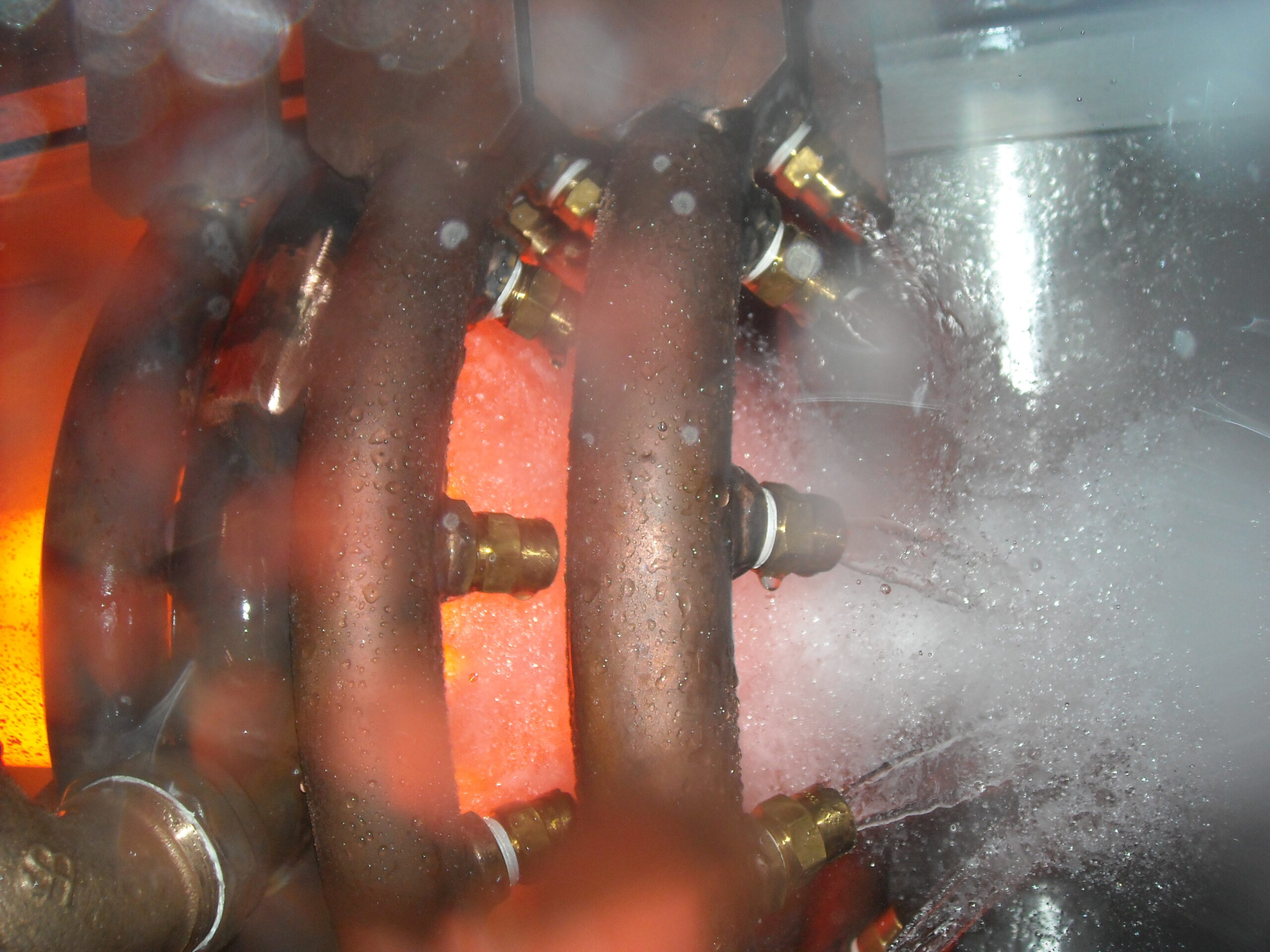
Normalizing is the third process in Interpower’s complete quench, temper, and normalizing line. In a normalizing cycle, the metal part is heated to a temperature above its critical range and then allowed to cool in open air. This controlled air cooling refines the grain structure of the metal, improves its mechanical strength, and relieves internal stresses that may have built up during prior manufacturing operations such as rolling, forging, or welding.
Compared to annealing, normalizing produces a harder and stronger result because the faster air cooling rate leaves less time for grain growth. For manufacturers working with carbon and alloy steels, normalizing is an important step toward achieving uniform microstructure and predictable performance across every part in a production run.
When normalizing is integrated directly into an induction line alongside quenching and tempering, manufacturers gain a continuous, controlled heat treatment process that reduces handling, minimizes material variability, and shortens overall cycle times.
Complete Turnkey Systems
How Interpower’s Induction Quench & Temper System Works
Interpower Induction is a single-source manufacturer of turnkey induction heating systems. Our induction quench and temper systems are engineered as complete, integrated lines that move parts through each stage of the heat treatment process in a continuous, controlled sequence.
Each system is designed around your part geometry, material, production rate, and available floor space. The key stages of our induction quench and temper machine process are:
Parts enter the induction coil where electromagnetic energy rapidly and uniformly heats the workpiece to the target austenitizing temperature. Induction heating can be used to precisely control the penetration depth and the design of the heating zone on the component. Frequency selection is tailored to your part size and the depth of treatment required, whether surface hardening or through-hardening.
Immediately following induction heating, the part passes through the quench section where it is rapidly cooled using water, polymer, or oil quenchant depending on the alloy and required metallurgical outcome. Quenching prevents phase transformations and other undesired low-temperature processes from occurring by minimizing the time span in which these processes are kinetically available. This rapid cooling locks in the hardened martensitic microstructure and establishes the surface and core hardness profile.
The quenched part then passes through a second induction heating station for tempering. Tempering is about reducing hardness stresses. The brittleness of the hardness structure is alleviated and its toughness improved. Induction heating allows tempering temperatures up to 650 degrees Celsius. Tempering brings the final mechanical properties of the part into balance, delivering the combination of hardness, toughness, and ductility your application demands.
For lines that include normalizing, a final controlled air-cooling stage follows tempering to refine grain structure and relieve residual stress before the part exits the system.
Interpower Induction’s quench, temper, and normalizing lines are complete induction heating machines that integrate coils, power supplies, and cooling to support metallurgical treatments. Every system is built to work as a single unified production line, not a collection of disconnected machines.
How Interpower’s Induction Quench & Temper System Works
- Single-Source Turnkey Delivery
- Modular, Space-Saving Design
- Pre-Installation Testing
- Advanced Zone Control Technology
- Designed, Built, and Repaired by Interpower
Interpower Induction is a single-source manufacturer of turnkey induction heating systems. From coil design and power supply integration through controls, material handling, and quench systems, we engineer, build, and commission the complete line. You work with one team from project kickoff through startup.
Our induction quench and temper systems are built on flexible modular sections that adapt to your available floor space and production layout. No pits. No foundations. The line can be reconfigured as your production needs change over time.
Interpower Induction provides customers with unique testing capabilities prior to installation. Before your system ships, it is tested and validated at our facility so that startup at your plant is faster and more predictable.
Our systems incorporate Zone Control Technology, which independently regulates power to multiple coil zones within a single converter. This allows optimal energy distribution across the length of the part, reduces losses, and gives operators precise command over the thermal profile at every stage of the process.
Hardening and tempering systems for heat treating designed, built, and repaired by Interpower Induction provide flexible quench and temper solutions to match customer production needs.
Our in-house capabilities mean you have a long-term partner for system support, coil rebuilds, and equipment upgrades throughout the life of your line.
Advantages of an Induction Quench & Temper Machine Over Conventional Methods
Manufacturers who switch from furnace-based heat treatment to an induction quench and temper machine typically see improvements across energy consumption, floor space, cycle time, and part quality. Here is how induction compares:
Speed
Induction heating enables faster heating cycles than conventional gas or electric furnaces because energy is generated directly within the part itself rather than transferred from an external heat source. This translates to higher throughput on continuous production lines.
Precision
Induction heating is the most energy-efficient and precise method for applying heat during the heat treating process. Power delivery can be adjusted in real time, and temperature profiles can be tightly controlled zone by zone across the length of the part. This level of precision is extremely difficult to achieve in a batch furnace environment.
Energy Efficiency
Because induction heats only the workpiece and not the surrounding air or fixtures, localized heating and direct coupling into the part minimize heat losses. Facilities running induction quench and temper systems typically realize significant reductions in energy costs compared to furnace-based alternatives.
Repeatability
Reproducible uniformity of the heat treatment process and its metallurgical results. is one of the core strengths of induction heating. Once a process recipe is established and validated, every part receives the same thermal treatment. This consistency is critical for high-volume production lines where part-to-part variation cannot be tolerated.
Floor Space
Interpower’s modular induction quench and temper systems are designed to fit within your existing plant layout. Flexible modular sections replace the need for below-grade foundations and pits, making installation and future reconfiguration significantly easier than traditional line designs.
Clean Operation
Induction heating generates no combustion byproducts, no open flames, and no flue gases. This reduces ventilation requirements and creates a cleaner, safer working environment for operators on the production floor.
Frequently Asked Questions
What is an induction quench and temper system?
An induction quench and temper system is a continuous heat treatment line that uses electromagnetic induction to heat metal parts to a precise target temperature, rapidly quenches them to achieve the desired hardness profile, and then tempers them at a lower temperature to reduce brittleness and optimize toughness. Interpower Induction designs and builds complete turnkey induction quench and temper systems that integrate coils, power supplies, quench sections, and controls into a single production line.
How is an induction quench and temper machine different from a furnace-based system?
A furnace-based system heats parts by surrounding them with hot air or radiant heat from chamber walls, which is a slower and less precise process. An induction quench and temper machine generates heat directly within the part itself through electromagnetic induction, resulting in faster heating cycles, tighter temperature control, lower energy consumption, and more consistent metallurgical results from part to part. Induction systems also require significantly less floor space and eliminate the need for pits or below-grade foundations.
What is the role of tempering in an induction hardening and tempering system?
After quenching, metal parts are in a hard but brittle martensitic state. Tempering reheats the part to a lower temperature using a second induction heating station, which relieves residual stresses and restores a controlled level of ductility and toughness. The tempering stage allows manufacturers to precisely tune the final mechanical properties of the part, striking the right balance between surface hardness and the ability to absorb shock and cyclic loading in service.
What types of parts can be processed on an Interpower induction quench and temper system?
Interpower induction quench and temper systems are capable of processing a wide variety of part types including bars, tubes, pipe, and other long products. Common applications include axle shafts, drill pipe, sucker rods, railroad components, fasteners, and structural steel products. System coil and conveyor designs are tailored to the geometry and dimensions of the specific parts being processed.
What is normalizing and when is it used in a quench and temper line?
Normalizing is a heat treatment process in which a part is heated above its critical temperature and then cooled in open air. It refines the metal’s grain structure, improves strength and toughness, and relieves internal stresses from prior manufacturing operations. Normalizing is incorporated into a quench and temper line when the material or application requires a more uniform microstructure before or after the hardening and tempering cycle. Interpower designs flexible lines that can include normalizing as a standalone section within the same production layout.
Can Interpower design a system to fit within an existing plant layout?
Yes. Interpower Induction’s quench, temper, and normalizing systems are built on a modular design approach specifically to address plant space constraints. Flexible modular process sections can be configured to fit your available footprint without the need for below-grade pits or structural foundations. Our engineering team works directly with your facility layout to produce a system design that integrates with your existing production flow.