
Induction Bonding
General Information
Application Features
- Localized Heating
- Fast Heating
- Heat-Moving Components
- Accurate Temperature Control
- Repeatability
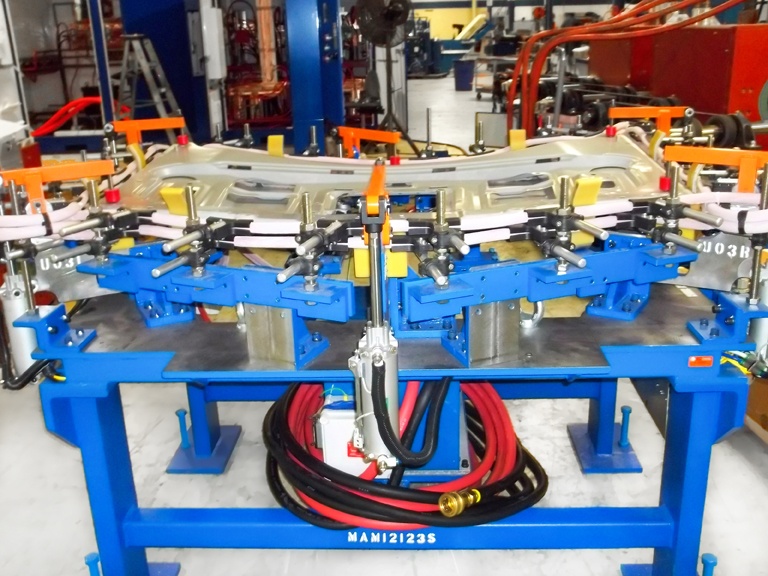
Key Features of Induction Bonding Equipment
Our induction bonding solutions use controlled induction heating to support bonding processes that depend on precise, localized thermal input. Systems are engineered around defined process requirements rather than generalized equipment assumptions.
Key features:
- Localized heating at the bond area using electromagnetic induction, reducing unnecessary heat exposure to the surrounding material.
- Configurable power output and heating cycles aligned to specific bonding parameters.
- Custom coil designs developed to match part geometry and bonding location.
- Repeatable heating profiles to support consistent bonding conditions across production runs.
- Rapid heat response and controlled shutoff to support predictable cycle times.
Induction bonding equipment can be configured as standalone systems or integrated into existing production cells. This allows bonding processes to align with current automation, fixturing, and material handling strategies without requiring major layout changes.
Applications of Induction Bonding Equipment
Induction bonding equipment is used in manufacturing environments where bonding processes rely on controlled heating of metal components. Applications are defined by the bonding method and thermal requirements rather than by generalized industry use cases.
Common application characteristics include:
- Bonding processes that require precise temperature control at a specific joint or surface.
- Manufacturing environments where consistent, repeatable heating is critical to bond quality.
- Operations where traditional heating methods make temperature control difficult or inefficient.
- Production settings that benefit from localized heating rather than bulk thermal exposure
Induction bonding may be used during process development to establish bonding parameters or implemented in production once those parameters are defined. The same induction heating approach can support both development and production use without changing the core heating technology.
Because induction bonding relies on electromagnetic heating, applications typically involve conductive materials and joint designs that allow effective heat transfer at the bond location. System configurations are developed based on the specific bonding process requirements rather than assumed material combinations or end uses.
For assembly processes that require joining plastic components to metal substrates using localized heat, our heat staking equipment offers a related thermal joining solution engineered for that specific application.
Frequently Asked Questions
What does induction bonding refer to?
Induction bonding refers to the use of induction heating to support a bonding process. The induction system delivers controlled heat to a targeted area of a metal component to enable or assist temperature-dependent bonding operations.
Is induction bonding a specific joining method?
No. Induction bonding describes the heating method, not the bonding technique itself. Induction heating can be used to support various bonding-related processes that require controlled thermal input.
Can induction bonding equipment be tailored to a specific process?
Yes. Induction bonding systems are engineered around defined process requirements, including power levels, coil geometry, and heating profiles needed to support the bonding operation.
Can induction bonding systems be integrated into existing production lines?
Induction bonding equipment can be configured for standalone operation or integrated into existing manufacturing cells, depending on production layout and process flow requirements.
What determines whether induction bonding is suitable for an application?
Suitability depends on the bonding process, required temperature control, part geometry, and material conductivity. These factors are evaluated when developing an induction bonding solution.