Billet Heating vs. Bar Heating: Understanding the Difference in Induction Forging
The billet heating vs. bar heating decision shapes nearly everything downstream on a forging line, from how stock is cut to how parts reach the press. Choose the wrong process and you pay for it in wasted energy, inconsistent temperatures, excess scale, or a heater that throttles production.
Both methods rely on the same principle of induction forging: an alternating magnetic field induces eddy currents inside the workpiece, so heat is generated in the metal itself rather than in the air around it. What separates the two is the form your stock takes when it reaches the coil. Below, we break down how each process works, where each one fits, and what forging plant engineers and production managers should weigh before specifying a system.
Why Your Heating Method Matters on the Forging Line
Every forging operation depends on getting the workpiece to the right temperature, uniformly, at the pace the press demands. According to a widely cited overview of induction forging, metals are typically heated to between 1,100°C and 1,200°C (2,010°F to 2,190°F) to make them malleable enough to flow in the die. The same source warns that applying too much power too quickly can melt the surface of a component while leaving the core cool.
That makes the heating method a metallurgical decision as much as a production one. Surface-to-core uniformity affects die fill, grain structure, and scrap rates, and the heater has to deliver it at the line’s cycle time without overshooting.
Induction vs. Gas Furnace Heating
Whether you heat billets or bars, induction offers clear advantages over gas-fired furnaces:
- Faster heat-up times, with power available on demand
- Precise temperature control through pyrometer monitoring
- Lower energy consumption, since only the workpiece is heated
- Reduced scale formation and fewer surface defects
- A smaller footprint and a cleaner, safer working environment
- Easier integration with automated production lines
How Induction Billet Heating Works
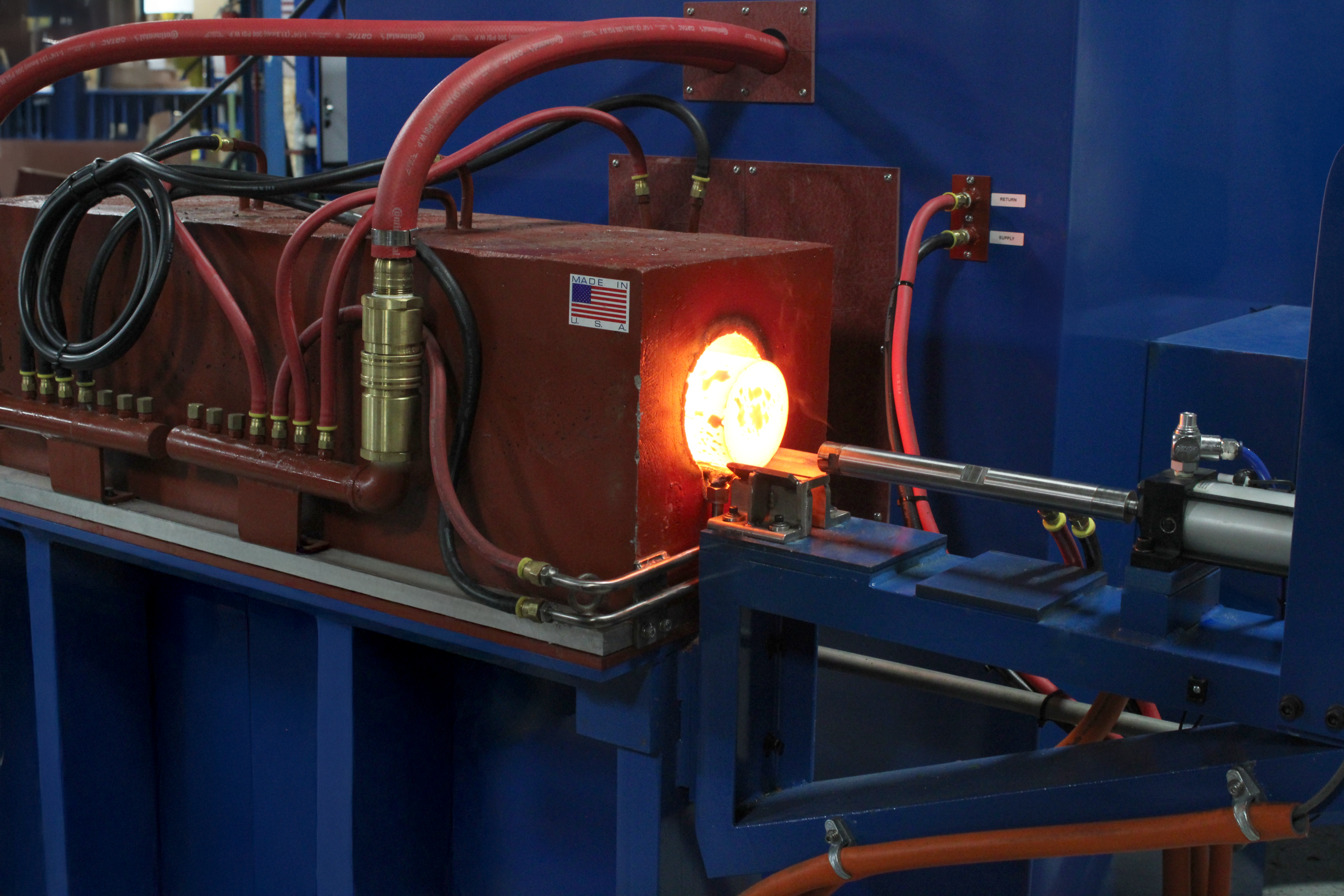
In billet heating, bar stock is cut into billets or slugs before it is heated. Each piece is fed through the induction coil, and the entire billet is brought to forging temperature. Short billets are typically fed in line, one after another, while long billets can be heated in a single shot. Coil length is set by the required soak time, the cycle time per component, and the length of the billet. For high-volume work on large sections, several coils may run in series.
Interpower induction billet heating systems handle billets and slugs of any dimension in carbon steel, stainless steel, aluminum, copper, titanium, and brass. Power ranges run from 6 kW up to several MW at frequencies of 500 Hz to 50 kHz, driven by Interpower IGBT transistor power converters.
Billet Heater Configuration and Material Handling
A complete billet heating system includes the induction power supply, coil assembly, material handling, and temperature monitoring. Tippers, loaders, feeders, and extractors move each billet into and out of the coil, and sorting equipment can divert parts that fall outside the target temperature. Compact and separate cabinet designs are available: compact models house the power supply and heater in a single cabinet, while separate versions split them into two.
Where Billet Heating Fits
- Press and closed-die forging of discrete parts from pre-cut billets or slugs
- Automated lines where loaders and extractors control part flow and cycle time
- Non-ferrous forging in aluminum, copper, titanium, and brass
- Operations that run a range of billet sizes and need flexible changeovers
How Induction Bar Heating Works
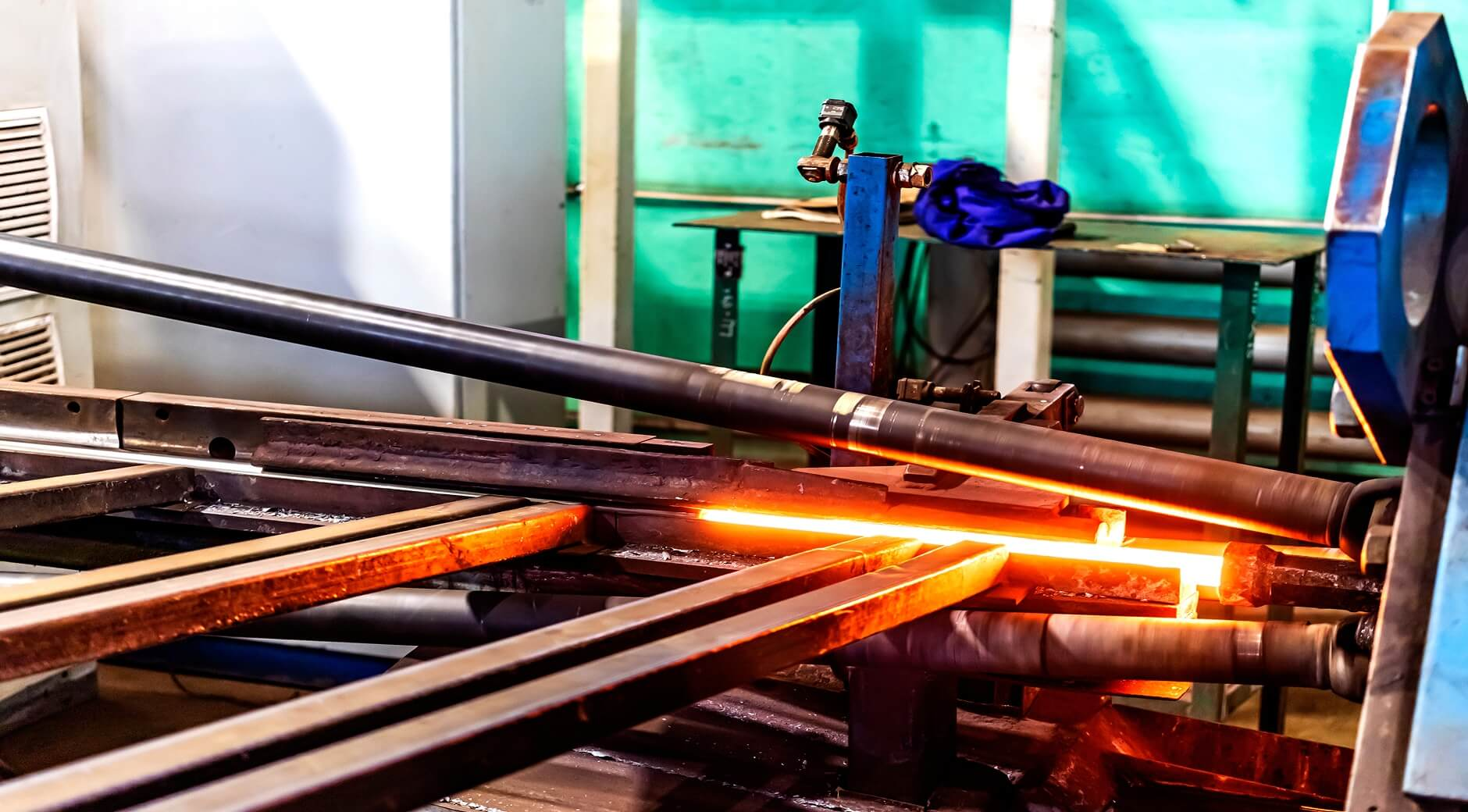
Bar heating raises full-length bars to temperature as they travel through the coil line, rather than heating individual pre-cut pieces. Pinch roll drives, conveyors, and roll feeders keep the bar moving at a controlled rate so the temperature profile stays consistent from end to end. This continuous approach suits processes that work the bar as it comes off the heater or that need long lengths at uniform temperature.
Interpower induction bar heating systems can bring steel bars to over 2,300°F (1,260°C), covering the requirements for most forging, rolling, and heat treatment work. Standard features include:
- Zone Control Technology: Advanced PLC control for precise, uniform surface-to-core heating
- Quick-release connections: Fast coil changeovers on power and water to minimize downtime
- Heavy-duty construction: Built for the heat, vibration, and cycle demands of forging environments
- Integrated material handling: Automated in-feed and out-feed, including conveyors and roll feeders
- Water cooling systems: Continuously cooled coils and components for maximum uptime
Where Bar Heating Fits
- Press and hammer forging of shafts, rings, and flanges
- Cross-wedge rolling for automotive and industrial components
- Grinding ball forging for SAG and ball mill media used in mining
- Through-heating before quenching and tempering
Grinding media is a good example of where bar heating shines. SAG mills and ball mills reduce ore into smaller particles, and the balls they use must be heated precisely before forging to reach the hardness the mill requires. Uniform, repeatable bar heating is what keeps that media consistent at production scale.
A Third Option: Bar End Heating
When only part of the bar needs to be forged, bar end heating concentrates energy on the end of the bar where the deformation happens. It is the standard choice for upset forging of bolts, fasteners, and valves, and it is also used for swaging, thread rolling, piercing, and heading. Depending on the part, bar end heaters can use solenoid coils, multi-station setups, skid coils, or channel coils for horizontal or vertical upsetting.
Billet Heating vs. Bar Heating at a Glance
- Stock form: Billet heating uses pre-cut billets or slugs. Bar heating uses full-length bars.
- Heating pattern: Billet heaters heat each piece completely. Bar heaters heat the bar continuously as it moves.
- Material handling: Billet lines use tippers, loaders, feeders, and extractors. Bar lines use pinch rolls, conveyors, and roll feeders.
- Power and frequency: Interpower billet heaters run from 6 kW to several MW at 500 Hz to 50 kHz. Interpower bar heaters range from 5 to 10,000 kW at 50 Hz to 50 kHz.
- Typical parts: Billets suit discrete forgings. Bars suit shafts, rings, flanges, rolled components, and grinding media.
How to Choose the Right Process for Your Line
Start with the part, then work backward to the heater:
- Confirm stock form and geometry. Pre-cut slugs point to billet heating. Long bars and continuous processes point to bar heating. Localized forming at the end of a bar points to bar end heating.
- Define throughput and cycle time. These set coil length, power, and the number of coils in the line.
- Match material and target temperature. Steel, aluminum, copper, and titanium each respond differently to induction, and each has its own forging window.
- Select the right frequency. Induced current flows mainly in the surface layer, and its penetration depth depends on frequency and the material’s permeability. The goal is the deepest practical penetration for your diameter so the core reaches temperature without overheating the surface.
- Plan handling and automation. Loaders, feeders, conveyors, hot-end handling, and robots determine how the heater ties into the rest of the line.
- Account for support systems. Water cooling, pump stations, and input transformers all need to be sized with the heater.
Questions to Answer Before You Specify a System
- What diameters and lengths will run on the line, now and in the next few years?
- How many parts per hour does the press or rolling operation need?
- Will the line run more than one material?
- How quickly do you need to change coils between jobs?
- What temperature tolerance does your process require at the die?
Interpower builds complete turnkey forge heating systems around these answers, including power supplies, coils, material handling, and water cooling, and offers repair services for the equipment it supplies.
Induction Forge Heating Built Around Your Parts
Interpower Induction has designed and built induction heating equipment since 1995. Whether your line runs billets, full bars, or bar ends, our engineers will configure a system to your materials, part sizes, and production targets.
Frequently Asked Questions
What is the difference between billet heating and bar heating?
Billet heating brings pre-cut billets or slugs to forging temperature one piece at a time, while bar heating heats full-length bars as they move continuously through the coil line. The right choice depends on your stock form, part geometry, and throughput.
What is the difference between bar heating and bar end heating?
Full-bar heating raises the entire bar to forging temperature, while bar end heating focuses energy on just the end of the bar where the forging operation takes place. Bar end heating saves energy when only localized deformation is needed.
What temperatures can induction bar heating systems reach?
Industrial induction bar heating systems can heat steel bars to over 2,300°F (1,260°C). That range covers the temperature requirements for most forging, rolling, and heat treatment applications.
How does induction billet heating compare to gas furnace heating?
Induction billet heating offers faster heat-up times, more precise temperature control, lower energy consumption, and less scale than gas furnace heating. It also takes up less floor space and integrates more easily with automated forging lines.
Can induction billet heaters process non-ferrous metals?
Yes. Interpower billet heaters are designed to heat billets and slugs in stainless steel, copper, aluminum, titanium, and brass, as well as carbon steel.